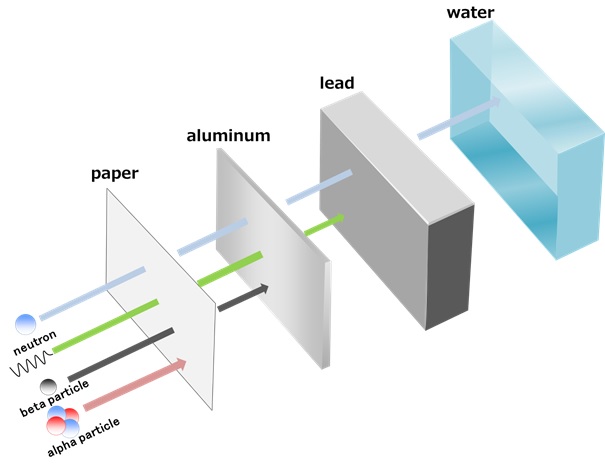
The main types of radiation that give rise to occupational and public exposures are alpha, beta, gamma and neutron.
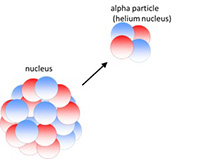
Alpha particles are emitted from the nuclei of heavy elements such as radium, uranium and plutonium. They deposit high densities of energy along their tracks and are very effective at causing biological damage. However, they can be stopped by material no thicker than a piece of paper. This makes them of little concernin respect of external exposure, but alpha-emitting radionuclides are highly toxic if they are inhaled. Most alpha-emitters are much less toxic if ingested orally, because they are generally only very poorly absorbed from the gut.
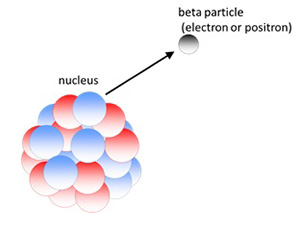
Beta particles are electrons (or positrons) emitted from the nuclei of both light and heavy elements. They have a range in tissue of a few millimetres, so can be of significance when beta-emitters are present as skin contamination. However, as with alpha-emitters, beta-emitters are mainly of concern following ingestion or inhalation. Because they only create relatively low densities of energy deposition along their tracks, they are generally less toxic than alpha emitters, though they are often better absorbed from the gut.
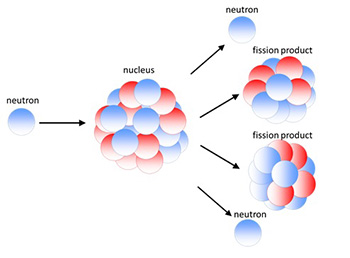
Neutrons are uncharged particles that are produced in nuclear fission and are mainly of relevance for external exposure. Within the body, they scatter off protons (hydrogen nuclei) and it is the recoiling protons that induce the biological damage. These protons give rise to densities of energy deposition that are intermediate between those of alpha and beta particles.
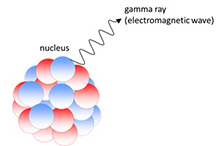
Gamma rays and x-rays are electromagnetic radiation. They are similar in nature to visible light, but of higher energy. They interact with electrons in tissues and it is the energetic electrons that they induce that cause biological damage. Thus, the way in which they induce effects is similar to that of beta particles. However, gamma ray and x-ray intensities are only slowly attenuated by tissues over characteristic distances of centimetres or more, so they can contribute to radiation effects either by external or internal exposure.
References
1) Martin, A and Harbison, S, An Introduction to Radiation Protection, Fifth Edition, Hodder Arnold, London, 2006